Research question
Can hierarchical co-occurrence structure be built into logistic regression while keeping the resulting risk model inspectable?
Condensed abstract
Formal Concept Analysis extracts closed itemsets from binarized health indicators. A closure penalty then encourages coefficients belonging to the same concepts to remain coherent while preserving a linear prediction function.
Key contribution
An interpretability-by-design objective that embeds FCA-derived structure directly into logistic-regression training, evaluated against linear and tree-ensemble baselines on a large survey-derived cohort.
My contribution
The published contribution statement credits Arman Salehi with conceptualization, methodology, coding, formal analysis, and writing the original draft.
Method overview
Closed itemsets are extracted from binarized indicators. The model adds a weighted within-concept coefficient-variance term to logistic loss; closure strength and minimum support are selected through cross-validation.
Find the structure inside the data
Baseline and current
The baseline stays fixed. Both figures use the same scales.
Dataset and evaluation
Data
Heart Disease Health Indicators derived from the 2015 Behavioral Risk Factor Surveillance System, with approximately 380,000 complete survey records after preprocessing.
Protocol
An 80/20 stratified split was used. Five-fold cross-validation within the training data selected closure strength and minimum support; the held-out test set was evaluated with discrimination, classification, imbalance-sensitive, and calibration metrics.
Main results
The held-out test set results were accuracy 0.906, AUC 0.810, precision 0.709, recall 0.544, F1 0.556, PR-AUC 0.265, and Brier score 0.078.
Baseline comparison
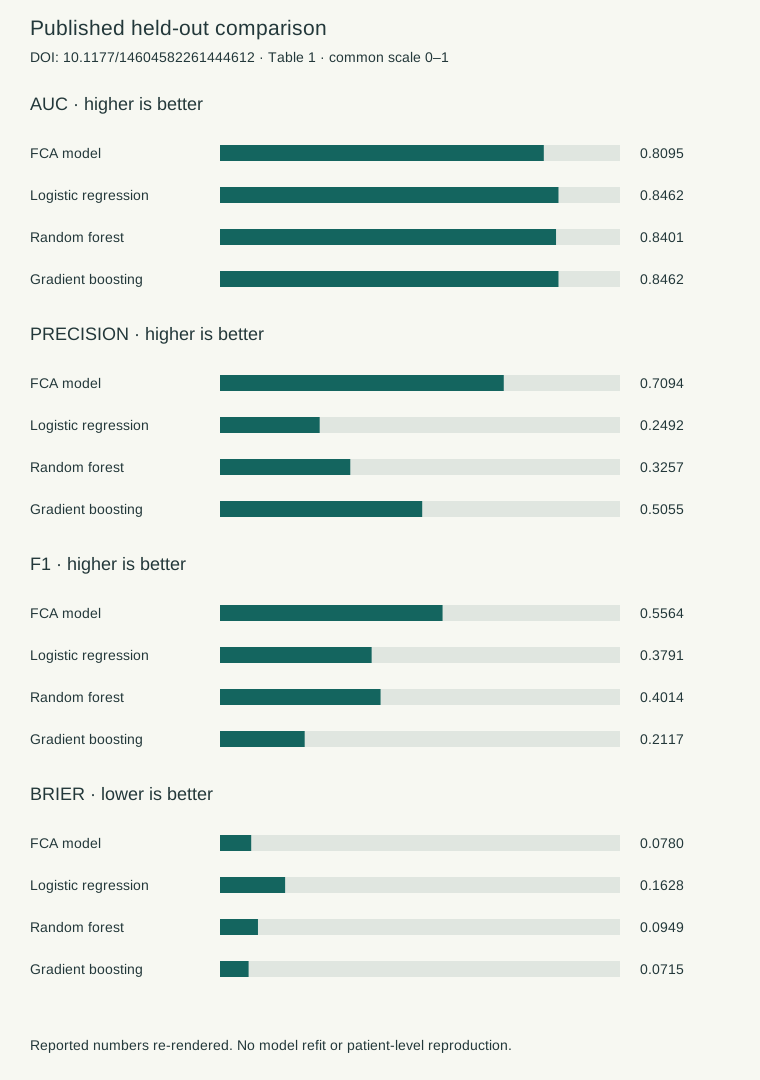
At the reported threshold, the FCA-constrained model had the highest precision and F1 among the listed baselines. Logistic regression and Gradient Boosting had higher AUC; Gradient Boosting also had the lower Brier score (0.0715 versus 0.078).
Limitations and failure modes
- BRFSS variables are self-reported, observational, and not a prospective clinical cohort.
- Binarization improves inspectability but discards information.
- The evaluation uses a single U.S. survey-derived dataset.
- External, subgroup, prospective, and workflow validation remain necessary before clinical use.
Reproducibility
A deterministic re-render and consistency check of the paper’s Table 1 held-out comparison.
Table re-renderedChecked locally 2026-09-05 · bundle v1.0.0
- Paper-associated code
- Zenodo record 18730141 This external archive is separate from the small check below. Its full environment was not executed here.
- Inputs for this check
- Four reported model rows and four metrics, supplied as JSON. Patient-level data are not required for this table check.
- Prerequisites
- Python 3.10+ · standard library only · CPU · no network or large dataset download. A notebook environment is optional.
- Full study data
- Heart Disease Health Indicators (BRFSS 2015) Consult the paper and dataset documentation before attempting the full study.
Run the small check
- Download and extract the complete bundle.
- Open a terminal in the extracted folder and run
python check.py. - Validate metric ranges, identify the best reported value for each metric, and render the table as a fixed-scale SVG.
Includes Python, an equivalent notebook, source JSON, expected output, and SHA-256 provenance. The notebook runs from the extracted folder.
Expected output and individual files
FCA leads precision and F1; logistic regression and gradient boosting tie on AUC; gradient boosting has the lowest Brier score.
What this does not establish
Re-rendering a published table is not an independent model refit. Concept extraction, preprocessing, threshold selection, and clinical validation are outside this check.
These checks use the portfolio’s existing sourced records. External archive links could not be freshly rechecked during package preparation. A passing check is not a full-paper replication.
The decisions behind the method
How structured constraints can keep a clinical-risk model inspectable, plus the validation still needed before deployment.
Read the research noteVerification sources
Cite this work
Arman Salehi, Ashkan Heydarian, Hamid Reza Goudarzi, Zahra Farzin Rad (2026). Interpretable heart disease risk prediction via FCA-constrained logistic regression. Health Informatics Journal. https://doi.org/10.1177/14604582261444612
BibTeX
@article{salehi2026fca,
  title = {Interpretable heart disease risk prediction via FCA-constrained logistic regression},
  author = {Arman Salehi and Ashkan Heydarian and Hamid Reza Goudarzi and Zahra Farzin Rad},
  year = {2026},
  doi = {10.1177/14604582261444612},
  journal = {Health Informatics Journal},
  publisher = {SAGE Publications}
}
Publication record last verified 2026-07-26.
Discuss this research
Have a question about concept constraints, calibration, or the precision–recall trade-off? Share the comparison you want to investigate.
Draft a research questionOpens your email app with the paper and current experiment. Nothing is sent automatically.